
By: Author Amanda OBrien

Image by Yilmaz Akin on Unsplash
In this post:
- The key traits that make Blue Point Siamese cats unique among cat breeds
- What to look for when choosing one, so you know it's a good fit for your home
- Why the "blue point" distinction actually matters, genetically and otherwise
- Practical tips for caring for and living with a Blue Point Siamese
Of all the gorgeous cats in the world, the Blue Point Siamese has a genuine claim to superstar status. Their striking coloring makes them a beautiful companion, but they're just as loving as they are lovely.
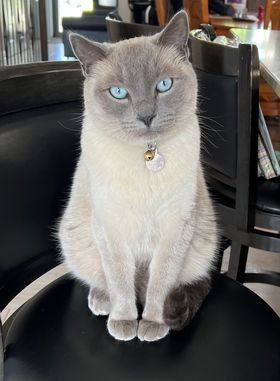
Don't be misled by the name, though — this cat isn't actually blue. Their eyes are usually a piercing blue, but "blue point" refers to their coat coloring, which is really a cool gray, and it's what distinguishes them from other types of Siamese cats.
Whether you're considering adopting one or just curious about one of the world's most recognizable breeds, here's what's genuinely worth knowing.
Why the Blue Point Distinction Matters
It's easy to assume "blue point" is just a marketing name for a gray cat, but the underlying genetics are worth understanding, since they explain a lot of what follows in this guide.
All Siamese cats carry a form of temperature-sensitive albinism: the enzyme responsible for pigment only works properly below a certain temperature. That's why color develops on the cooler extremities (face, ears, legs, tail) and stays paler on the warmer body — and why every Siamese kitten is born essentially white, with points darkening in over the following weeks as their extremities cool relative to their core.
"Blue" specifically is the dilute version of the breed's original seal (dark brown-black) coloring — the same dilution gene that turns black into gray/blue elsewhere in the cat world. That's also why you'll sometimes see this cat searched for as a "blue color point cat," "blue colorpoint cat," or simply "dark gray Siamese" — all describing the same genetic trait.
1. History and Popularity
Siamese cats are believed to originate from the historic Kingdom of Siam (modern Thailand), with references dating back centuries. They first made an impression on the Western world around 1890, when their striking appearance was still a novelty outside Southeast Asia.
The breed itself was among the founding breeds recognized by the Cat Fanciers' Association (CFA) in 1906 — one of the earliest pedigree breeds recognized in the West. Blue point specifically came later: CFA formally recognized the blue point coloring in 1934, with chocolate point following in 1952 and lilac point in 1955. (The International Cat Association, TICA, wasn't founded until 1979, so if you've seen "TICA recognized blue point in 1934" elsewhere, that's a mix-up between the two organizations — worth clarifying since dates and registries get conflated a lot in Siamese breed content online.)
2. Traditional vs. Modern Body Types
There's a real, visible difference between older-style Siamese cats and the more streamlined show-style cats most people picture today, and it's worth understanding before you go looking for a kitten — the term "applehead" comes up a lot in searches and it isn't just aesthetic trivia.
Applehead (traditional/Thai-style) Siamese have a rounder head, sturdier and more muscular build, and a shorter, less extreme nose profile. This look is closer to the original cats first exported from Thailand. Some registries (TICA, WCF, FIFe) recognize this traditional body type as its own breed, called the Thai cat, distinct from the modern Siamese standard — so if you're searching for a "blue point Thai cat," you're technically looking at a different (though closely related) breed with its own standard, not just an old-fashioned Siamese.
Wedge-head (modern) Siamese — what most breeders and CFA shows favor today — have the elongated, slender body, triangular wedge-shaped head, and large ears most people associate with the breed now. Modern Siamese also tend toward a leaner, more angular look overall.
Both body types can carry the blue point coloring; body type and coat color are separate, independent traits.

Image by Barb93 on Pixabay
3. Blue Point Siamese Physical Characteristics
Modern blue point Siamese have blue-gray point markings against a cooler white-to-bluish-white body, an elongated slender build, a triangular head, almond-shaped eyes, and prominent large ears. Most purebred Siamese have short, fine fur, though longer-haired individuals occasionally appear (and are recognized separately as Balinese cats if the long-hair gene is present).
4. Blue Point Kittens Are Completely White at Birth
As covered above, this comes down to temperature-sensitive pigmentation: in the womb, a kitten's whole body stays warm and uniform, so no point color develops. Once born and exposed to normal room temperature, the cooler extremities begin developing color — you'll typically start to see it appear around 6–8 weeks of age, continuing to darken somewhat as the cat matures into adulthood.
5. Is the Blue Point One of the Rarer Siamese Colors?
The Blue Point is one of the four original, traditional Siamese colors (alongside Seal, Chocolate, and Lilac Point), and it's genuinely less common than Seal Point — the most frequently seen and historically original coloring, since Seal Point doesn't require the dilution gene that Blue Point does. That said, "less common than Seal Point" doesn't mean genuinely rare: Blue Point is one of the more readily available and well-established Siamese colors, considerably easier to find than the rarer Chocolate and Lilac Points, let alone Siamese-adjacent color varieties like Red, Cream, or Tortie Point, which are rarer still. If you've read that Blue Point is "rare," it's really a matter of degree — rare relative to Seal Point, common relative to most everything else.
Chocolate Point cats have paler brown markings on a cream-colored body; Lilac Point (sometimes called Frost Point) has a soft pinkish-gray tinge on a near-white body, and is the lightest of the four. Coloring has no meaningful effect on temperament — a Blue Point behaves like any other Siamese.
6. Blue Point Siamese Cat Prices
Prices vary widely by breeder and region, but commonly cited ranges for a pedigree Blue Point Siamese kitten run roughly $500–$1,500 in the US, sometimes higher for show-quality lines or specific registries. Given how popular Siamese cats are generally, you shouldn't have to search too hard to find a breeder — which is actually a reason for extra caution, not less.
Don't default to the cheapest option without asking real questions first. A breeder unwilling to discuss health testing (see the PRA section below), let you meet the kitten's parents, or answer questions about their breeding practices is a red flag — cheaper kittens sometimes come from operations that aren't caring for litters properly, which can mean a sick or malnourished kitten down the line.

Adoption is worth checking too — Siamese-specific and Oriental breed rescues do exist, and a rescued adult Siamese often comes with a known temperament already on display, which can make for an easier match than a kitten.
7. Blue Point Siamese Personality
Coat color doesn't change temperament, and the Siamese personality is famously consistent regardless of point color. Despite their elegant look, they're friendly, highly affectionate, and playful — genuinely one of the more people-oriented breeds you'll find, making them a great fit for family households that can offer plenty of social interaction, including, in many cases, getting along well with dogs.

8. Blue Point Siamese Can Get Quite Chatty
Siamese cats are known for a genuinely impressive vocal range, and Blue Points are no exception. Expect frequent, insistent meowing that often escalates if ignored — these cats want a response, not just attention. If you'd prefer a quiet cat, this isn't the breed for you, full stop.
If the vocalizing becomes genuinely excessive or seems to signal distress rather than normal chattiness, it's worth ruling out anxiety, boredom, or a medical cause with your vet rather than assuming it's just "how Siamese are" — enrichment (see the training and exercise sections below) often meaningfully reduces attention-seeking vocalization in an under-stimulated cat.
9. Blue Point Siamese Can Develop Separation Anxiety
The flip side of such a socially dependent breed is that they generally dislike being left alone for long stretches. This isn't unique to Blue Points — it's a Siamese-wide trait — but it's worth taking seriously: these cats can become genuinely distressed by prolonged isolation, showing signs like excessive vocalization, changes in appetite, or over-grooming.

Image by [kaˈmeːli̯ə] on Unsplash
If your household is regularly out of the house for long periods, a Siamese (Blue Point or otherwise) may not be the ideal fit unless you can offer a companion cat or significant daily engagement to offset the alone time. A feline behaviorist or your vet can help if separation-related distress becomes a real problem rather than mild clinginess.
10. Feeding and Diet
Blue Point Siamese don't have a documented breed-specific need for special food, and it's worth being cautious about a claim you'll sometimes see online — that their pedigree or "inbred" history makes them inherently more prone to food allergies. There isn't solid evidence connecting Siamese ancestry specifically to elevated food-allergy rates; individual cats of any breed can develop food sensitivities, and if yours shows signs (vomiting, diarrhea, itchy skin, poor coat condition), a vet-guided elimination diet — sometimes using a single novel protein or a limited-ingredient formula — is the standard way to identify a trigger, not a preventive step you need to take by default.
A good-quality, balanced commercial diet is generally all a healthy Blue Point Siamese needs. If in doubt, get your cat weighed and talk to your vet about the right feeding plan for their age and activity level.
11. Energy and Exercise
Blue Point Siamese are genuinely active and need real mental stimulation to match their intelligence — often compared to dogs in this respect. Alongside company (human or feline), stock up on cat toys: while their hunting instincts aren't as sharp as some breeds, they'll happily chase a wand toy, string toy, or laser pointer.
On outdoor access: Siamese cats can technically go outdoors, but most breed experts recommend keeping them strictly indoors or providing only supervised, enclosed outdoor time (a "catio" or leash-walked time in a secure yard). The reasons are practical rather than breed-specific: their striking appearance and value make them a target for theft, and like any cat, they face real risks from traffic, other animals, and disease outdoors. If you want your cat to experience the outdoors safely, a secured enclosure or harness training (see below) is the safer route.
12. Blue Point Siamese Can Be Trained
Like the rest of the Siamese family, Blue Points are genuinely trainable — training itself doubles as enrichment and bonding. Positive reinforcement (treats plus repetition) works well, and many Siamese enjoy learning fetch.
Harness and leash training is worth calling out specifically, since it's one of the more common ways owners give this breed safe outdoor time. Start indoors: let your cat wear the harness alone for short stretches before attaching a leash, use treats to build a positive association, and only move outside once your cat is calm and comfortable indoors. Go at your cat's pace — some Siamese take to it quickly, others need weeks of short, low-pressure sessions. A qualified feline behaviorist can help if your cat seems anxious rather than just cautious.
13. Grooming Your Blue Point Siamese
Thanks to their short coat, grooming is inexpensive and doesn't need to be frequent. A weekly brush with a fine-tooth comb removes loose or dead hair, and brushing teeth two to three times weekly helps with dental health (Siamese are known to be somewhat prone to dental issues, so this is worth taking seriously rather than treating as optional).

Image by Juan Ignacio Escobar Tosi on Unsplash
Trim nails periodically, and provide a scratching post to help manage nail length naturally between trims. Starting grooming young, as a kitten, makes the whole routine far easier to maintain as an adult.
Health Beyond PRA
Progressive Retinal Atrophy (PRA) is a genuine, well-documented concern in the Siamese breed — it's a genetic condition causing gradual retinal degeneration that can progress to blindness, and it's DNA-testable. Reputable breeders should be able to show PRA test results for a kitten's parents; ask directly rather than assuming a breeder has already done this. It's worth knowing PRA isn't painful, and cats generally adapt very well to progressive vision loss with a stable, familiar home environment.

Image by Felix Mittermeier on Unsplash
But PRA isn't the only condition worth knowing about in this breed:
- Amyloidosis — a genetic predisposition to abnormal protein buildup, most often affecting the liver in Siamese cats. There's no DNA test for this one currently, so regular vet checkups (especially bloodwork as your cat ages) are the main way to catch it early.
- Feline asthma — Siamese cats have a somewhat elevated rate of asthma and respiratory sensitivity. Signs include coughing, wheezing, or labored breathing; it's manageable with vet-guided treatment (often inhaled medication via a cat-specific spacer device) but not something to dismiss as "just a cough."
- Dental disease — as mentioned above, Siamese are prone to periodontal issues, partly linked to jaw structure.
- Certain cancers — Siamese have a documented somewhat higher rate of a few cancers, including intestinal and mediastinal lymphoma, compared to the general cat population.
None of this should be alarming on its own — most Siamese live long, healthy lives — but it's worth discussing family health history with any breeder and keeping up with regular vet visits, particularly from around age 7 onward.
Lifespan
Siamese cats, Blue Point included, are generally a long-lived breed — commonly cited in the range of 15–20 years with good care, which is longer than average for a pedigree cat. Genetics, weight management, dental care, and prompt attention to the conditions above all play into how long and how comfortably your cat lives.
Comparison to Other Colorpoint Breeds
If you like the pointed-coat look but aren't sure Siamese specifically is right for you, a couple of related or similarly-patterned breeds are worth a look:
- Ragdoll: Also commonly seen in blue point (among other colors), but a completely different personality and body type — large, famously floppy and relaxed when held, and much quieter than a Siamese. If you want the blue-point look without the constant conversation and higher activity level, a Ragdoll is worth researching.
- Tonkinese: A cross between Siamese and Burmese, offering a softer, more muted "mink" version of the pointed pattern along with a personality often described as a toned-down Siamese — social and vocal, but generally a bit mellower.
Both share some genetic and aesthetic DNA with the Siamese, but neither is a like-for-like substitute — if the Siamese personality (highly vocal, highly social, needs constant engagement) is what draws you in, the Blue Point Siamese itself remains the more direct match.
Multi-Pet Households
Blue Point Siamese generally do well in multi-pet homes, provided introductions are handled with the usual care. Their social, people-oriented nature often extends to other animals too, including dogs in many cases — though as with any cat, individual personality and proper, gradual introduction matter more than breed alone. If your household already has pets, look for a breeder or shelter that can speak to how a specific kitten or cat has interacted with other animals so far.
Final Thoughts: Blue Point Siamese
You probably didn't need convincing that these are special cats, but hopefully you now have a clearer, more accurate picture of what actually sets a Blue Point Siamese apart — genetically, physically, and in terms of care.
Whether you're drawn in by their constant affection, their chatty personality, or simply the striking blue-gray coloring, the Blue Point Siamese is a genuinely rewarding companion for the right household — one with time, patience for their vocal nature, and a willingness to stay on top of their specific health considerations. It's no wonder they've remained popular for well over a century, alongside other blue-eyed cat breeds that catch our attention the same way.
Don't miss our article on the Seal Point Siamese Cat.

Amanda created and owns The Discerning Cat. A lifelong cat lover she is the proud parent of two Siberian cats, Alexei and Vladimir. She is passionate about understanding cats and different cat breeds.
Amanda created and owns The Discerning Cat. A lifelong cat lover she is the proud parent of two Siberian cats, Alexei and Vladimir. She is passionate about understanding cats and different cat breeds.


