
By: Author Amanda OBrien
In this post:
- The key differences between all 17 Siamese cat varieties, so you can identify which matches your lifestyle
- What to evaluate — temperament, body type, coat, and energy level — when choosing the right Siamese for your home
- Why these differences matter for day-to-day care, and how they affect a cat's needs long-term
Hailing from Thailand, Siamese cats have become famous for their striking looks and distinct personalities, making them one of the most expensive cat breeds around. Over the decades, breeders have developed a wide range of Siamese cat types that are sought after worldwide.
There are 17 recognized types of Siamese cats, varying in body type, color, and pattern. With that many options, it's easy to feel overwhelmed trying to work out which one is right for you.
That's why this guide covers the history, defining features, and differences of each type — so you're well prepared to choose the feline that fits your home.

You might enjoy more of our articles on Siamese cats: Siamese Cat Personality, Siamese Cats, Are Siamese Cats good mousers?, Why do Siamese Cats meow so much?, When do Siamese cats stop growing, Are Siamese Cats mean?, Do Siamese Cats shed?, How big do Siamese Cats get?, and Male vs Female Siamese Cats.
17 Types of Siamese Cats
Siamese types are generally classified two ways: by head and body shape, and by color point. Broadly, there are two body-type categories — traditional and modern — and within each, cats can appear in any of the recognized color points.
Traditional Siamese cats are usually grouped into three types: Applehead, Classic, and Old-style. Modern Siamese cats are usually grouped as Wedge, with color variations split into light-colored and dark-colored point families. Each is unique in its own way — here's how they vary and how to tell which is which.

Traditional Siamese Cats
Traditional Siamese cats trace back to the nation of Siam, now Thailand. Early depictions of Siamese-type cats appear in Thai manuscripts dating to the 14th century, showing how long these cats have been admired.

A well-known folk tale explains the crooked tail and crossed eyes once common in the breed: the story goes that Siamese cats were tasked with guarding royal goblets, wrapping their tails around them and staring so intently that their eyes crossed. It's a charming story — whether or not you believe it is up to you. In reality, both traits were more common in the breed historically and have been bred out of most modern lines over time, though they still occasionally appear.
The earliest Siamese cats brought West had light-colored coats with darker markings on the paws, face, ears, and tail — the color contrast now called a seal point.

Through selective breeding, Siamese cats now come in a wide range of colors, including blue, chocolate, and lilac — the Cat Fanciers' Association (CFA) recognized the blue point in 1934, the chocolate point in 1952, and the lilac point in 1955, in addition to the original seal point.
Below you'll find the defining features of each traditional variant.
1. Classic Siamese Cats
Famous for their athleticism, Classic Siamese cats have long bodies and tails, without the pronounced nose dip you'll see in some other traditional types.
Genetically, Classic Siamese cats are very similar to other traditional types — it's mainly their physical build that sets them apart.

classic siamese cat
You might enjoy our articles on Siamese Cat Colors, Flame Point Siamese Cats, Lynx Point Siamese Cats, Lilac Point Siamese Cats, Chocolate Point Siamese Cats, Cinnamon Siamese Cats, Tortoiseshell Siamese Cats, Seal Point Siamese Cats, Silver Point Siamese Cats, and Striped Siamese Cats.
Classic-type Siamese have a smooth body with a rounded head, piercing blue eyes, and dark points that stand out against a cream-colored body.
Their energetic, agile nature means they thrive on activity. If you're a pet parent to this action-loving feline, plenty of interactive toys will keep them happily chasing, nibbling, and (attempting to) catch things all day.
2. Applehead Siamese Cats
Known as the quieter version of the traditional Siamese, the Applehead's most distinguishing feature is its rounded, apple-shaped face. In terms of coloring, Appleheads have the original dark brown-black points seen in other traditional types. They also have bigger bones and a more muscular build.

applehead siamese cat
Like the Classic Siamese, Appleheads are athletic, but their tail is shorter than other traditional variants. The most noticeable behavioral difference is their quieter nature — they're less chatty, making this a good choice if you want a Siamese-type cat without quite as much vocal demand.
These cats tend to favor lap time and cuddling up next to you on the sofa, and often have slightly fluffier, longer fur than their more streamlined relatives.
A note on breed recognition: The Cat Fanciers' Association (CFA) doesn't recognize the Applehead as a separate breed from the modern Siamese — both fall under CFA's single Siamese standard, which favors the modern (Wedge) look in competition. The traditional, rounder-headed type is instead recognized as its own breed called the Thai cat by organizations including The International Cat Association (TICA), the World Cat Federation (WCF), and FIFe. If you're specifically after the traditional look, searching for "Thai cat" breeders alongside "Applehead Siamese" will widen your options.
3. Old-style Siamese Cats
Old-style Siamese cats have a medium-sized body and were especially popular during the 1950s and 1960s. Their facial structure sits between the Applehead and the modern Wedge Siamese.
They have broad ears and an almond-shaped nose, and the cross-eyed trait — while rare in modern lines overall — is more often seen in this type. Compared to other traditional types, Old-style Siamese tend to have longer faces.

old style siamese cat
Their body is longer and less bulky than the Applehead's but not as slender as the modern Wedge's. This balanced look is part of why they were so popular in the '50s and '60s.
These cats are athletic and talkative, and they get strongly attached to their owners — expect them to follow you around the house and let you know, vocally, if they feel ignored. If you leave them alone too long, you'll hear about it in the form of the classic Siamese cat meow.
Some modern breeders are working to bring this look back. If you're interested, the Old Style Siamese Cat Club is active in the UK, and PREOSSIA (the Preservation of the Original Siamese Cat) works toward similar goals in the US.
Modern Siamese Cats
When Siamese cats were introduced to Western countries, they quickly became fashionable pets. Over time, breeders developed a leaner, more angular look distinct from the traditional body type.
Modern Siamese cats have longer, thinner bodies than traditional ones, and are known for being especially vocal — expect loud, distinct meows throughout the day as your cat follows you everywhere around the house.
Selective breeding through the mid-to-late 20th century produced the Wedge body type along with a wide range of color-point varieties. While their appearance differs substantially from the traditional types, modern Siamese share the same core personality traits the breed is known for: intelligence, affection, a need for closeness, and near-constant conversation.
4. Wedge Siamese Cats
Named for the wedge-like shape of their head, these are the most extreme-featured type of Siamese you'll find, and the type most commonly seen in the show ring today. They have a lean, muscular body with long legs, a thin tail, wide-set ears, and a sharp, elongated face with slightly slanted eyes.
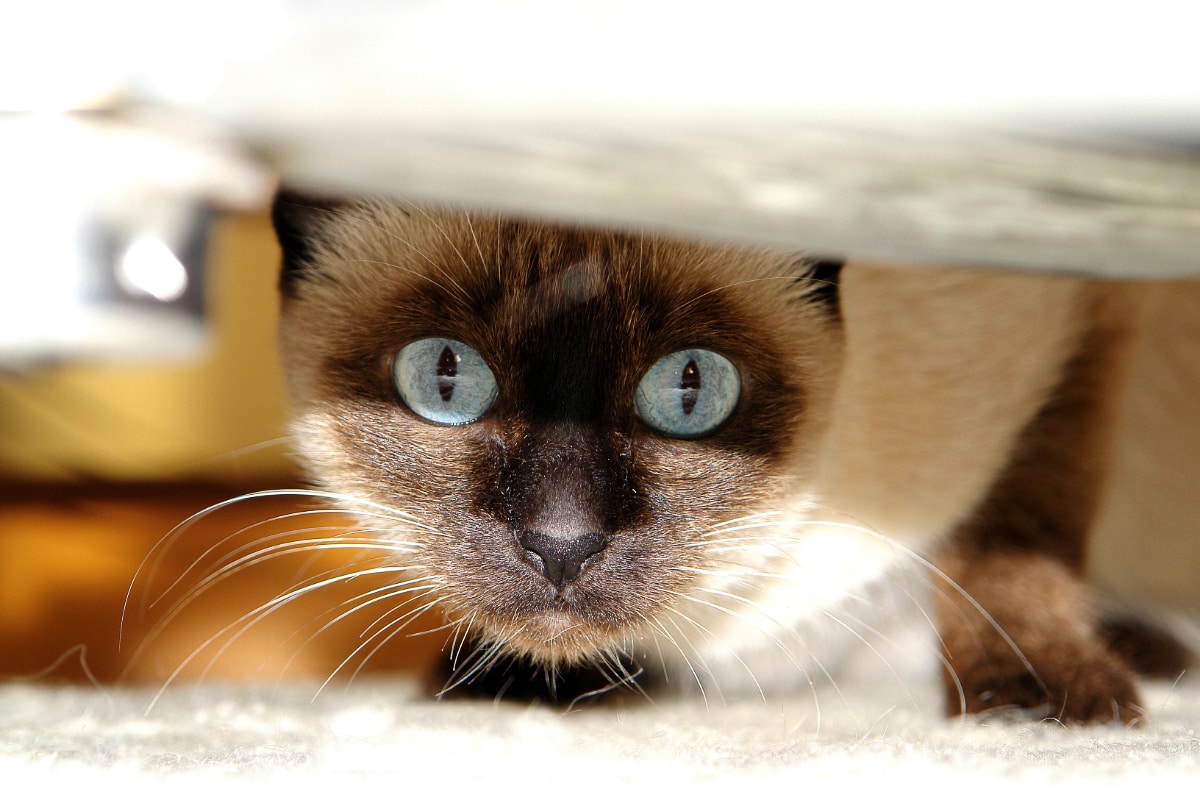
wedge siamese cat
They're also often considered the most vocal type — ask any Wedge Siamese owner and they'll tell you all about their cat's running commentary throughout the day.

wedge grey siamese cat
A correction on health claims: It's a common claim online that Wedge Siamese specifically are more prone to kidney disease due to their body type — but that's not quite accurate. The Siamese breed as a whole (across all body types) has a well-documented genetic predisposition to amyloidosis, a condition where abnormal proteins build up in organs — in Siamese cats, this most often affects the liver rather than the kidneys, though kidney involvement can occur too.
This predisposition runs in certain family lines rather than being tied to head or body shape specifically. It's a good reason to ask any Siamese breeder about their bloodline's health history, regardless of which body type you're considering — see the health section further down for more detail.
Like all Siamese, Wedge cats do best with plenty of toys, scratching posts, and climbing opportunities to keep them mentally and physically occupied.
Light-colored Siamese Cats
Breeders haven't only changed the physical build of Siamese cats through selective breeding — coat color has diversified considerably too. Here are the lighter color-point varieties.
5. Cream Point Siamese Cats
Cream Point cats belong to the light-colored family and have almost no dark patches. They have a cream or light orange base with soft fur and the breed's traditional blue eyes. Cream Points tend to have pale pink paws, noses, ears, and eye rims — kittens are born nearly all white, with their extremities darkening as they mature.
The Cream Point line traces back to outcrossing between Red Point Siamese and other breeds carrying the cream/red color genes, which is why it's not uncommon to see faint stripes on the face, legs, or tail resembling the coat pattern of domestic shorthairs.
Because the Cream Point's color isn't linked to a specific personality gene, temperament varies more by individual cat, socialization, and how they're raised as kittens than by color alone.

cream point siamese cat
6. Lilac Point Siamese Cats
The Lilac Point has a white body with lilac or gray-tinted extremities, classic blue eyes, and a pinkish nose and paws.
Also known as the Frost Point Siamese, this type has the lightest coat color of any Siamese — a cool, glacial white that stays consistent throughout their life. The Lilac Point is genetically a dilute combination of the Chocolate and Blue Point colorings.
Anecdotally, many owners describe the Lilac Point's voice as especially distinctive — often called "yodel-like" for its range and theatrical quality.

blue point and lilac point siamese cats
7. Chocolate Point Siamese Cat
Often confused with Seal Points, Chocolate Point Siamese cats have a cream-colored base with warm chocolate-brown extremities, creating a striking contrast against their ivory bodies.
This type is typically playful, curious, and friendly, making a good house cat that gets along well with other household members and pets. That said, their high energy levels mean they'll find their own entertainment if left to their own devices — so plan on providing plenty of stimulation.

chocolate points siamese cat.
8. Apricot Point Siamese Cats
Apricot Points have glossy white or hot-cream fur with pinkish points, particularly noticeable on the tail, nose, and under the paws — sometimes with light freckling around the lips and ears. Their coloring comes from a dilute modifier gene that shifts the more common Cream Point coloring toward apricot, and they often have a slightly paler, dulled blue eye color.
Beyond coloring, Apricot Points share the same personality traits as other Siamese — playful, affectionate, and prone to mischief if bored, so a companion cat or plenty of interactive toys go a long way.
9. Cinnamon Point Siamese Cats
A newer color variety, the Cinnamon Point resembles the Chocolate Point but with less intense, warmer reddish-brown extremities. Like the Chocolate Point, they have an ivory base with pale pink paw pads, though the pink is usually less visible beneath the cinnamon coloring, and their legs tend to run paler than the rest of their points.
The Cinnamon Point Siamese Cat is affectionate and loves attention, much like the rest of the family.
10. Fawn Point Siamese Cats
Considered the dilute version of the Cinnamon Point, Fawn Points have paler, cooler fur tones similar to the Lilac Point. Their coat carries warm rose-pink and mushroom tones over an off-white, magnolia-like base, with a pink tint around the eye rims, nose, and paws.
Fawn Points are known to be sensitive and can be prone to separation anxiety. They thrive on company — human or feline — so consider a second cat if you're often out of the house.
11. Caramel Point Siamese Cat
The newest color in the group, the Caramel Point carries a dilute modifier gene that produces blue, lilac, and fawn tones together. Because their coloring develops slowly, kittens may look lilac, then blue, before their brown undertone fully emerges.
Caramel Points have an off-white coat that darkens gradually with age, along with pink paws, eye rims, and nose with a gray undertone, and brown-gray legs.
Personality-wise, Caramel Points tend to resemble their Blue and Lilac Point relatives — clever, opinionated, and not shy about letting you know when they disapprove of something.
Dark-colored Siamese Cats
12. Seal Point Siamese Cats
The Seal Point is the original, most classic Siamese coloring — generally darker than the light-colored varieties, with deep brown-to-black markings on the face, tail, and paws that continue to darken with age, set against a white or cream base.
Siamese cats carry a temperature-sensitive pigmentation gene, which is why kittens are born almost entirely white and their points darken as they grow — cooler areas of the body (extremities) develop darker color, while warmer areas stay lighter.
Seal Points have a reputation for a dignified, somewhat independent temperament compared to some of the chattier types — but they're still Siamese through and through, and love affection, cuddles, and playtime just as much.

Seal Point Siamese Cat
13. Blue Point Siamese Cats
Blue Point Siamese have a bluish-white base with light gray points carrying a blue undertone, plus deep aquamarine, almond-shaped eyes. Their face shape can look triangular or slightly rounder depending on age, sex, and build, but their ears, slender body, and long tail all follow the classic Siamese silhouette.
Blue Points are loving, loyal, and highly social, with a sharp intellect that they're not afraid to use to get your attention — chewable toys and enrichment help redirect that energy productively.
14. Red Point Siamese Cats
Unlike most Siamese colorings, Red Point Siamese have white or cream fur with red, orange, or amber extremities and sparkling blue eyes.
Known as the Flame Point Siamese in places like the UK, this coloring is relatively rare and isn't accepted by every cat association. Red Points often have pink, sometimes freckled, eye rims, noses, ears, and paws.

Red Point Siamese also carry the agouti gene (also seen in Tabby Point Siamese), which can produce faint stripes on the legs and tail.
Genetically distinct from other Siamese lines, Red Points still share the breed's witty, affectionate, attention-loving personality, and may experience separation anxiety if left alone too long. They're generally friendly and adaptable around strangers, children, and other pets, including dogs.

red point siamese cat
15. Tortoiseshell or Tortie Point Siamese Cats
The Tortoiseshell or Tortie Point Siamese is a variant of the Red Point line, with a creamy white base, reddish-orange points, and intensely blue eyes. Unlike solid-colored points, the Tortie's points are flecked or mottled — resembling a tortoiseshell pattern — a trait linked to a genetic quirk that shows up almost exclusively in female cats.
Tortie Points have a distinctive masked face combining seal, white, and red tones, with the same mixed coloring often visible on the ears, paws, legs, and tail.
Personality-wise, they're intelligent, outgoing, and enjoy being close to their people — though their frequent vocalizing can come across as demanding if you're not used to a talkative cat.
16. Lynx Point Siamese Cat
The Lynx Point Siamese cat results from crossing Seal and Tabby lines, giving it striped extremities in blue, red, seal, chocolate, or cream, depending on the individual cat.

Lynx Points have a slender, medium build similar to the traditional Siamese, with spotted whisker pads, striped markings around the eyes, cheeks, and ears, striped legs, and ring markings on the tail.
Like the rest of the Siamese family, Lynx Points love company, crave affection, and are notably clever. They tend to be quite vocal, and will meow, tug at your attention, and generally persist until they get what they want.

Outside of attention-seeking moments, Lynx Points are fairly laid-back and enjoy sitting on laps and cuddling.
17. Tabby Point Siamese Cat
Tabby Points stand out from the rest of the group for their tabby-style brownish-gray dotted markings and stripes, particularly around the face, eyes, and nose. Leg striping tends to be paler, with ring markings visible under the tail.
Tabby Points also have a clear "M" marking on the forehead and a thumbprint pattern on the ears — the most visually varied color pattern in the Siamese family, since it can resemble almost any of the other point colors on this list.
Personality-wise, though, they're not much different from their relatives: affectionate, intelligent, and social.
For more on the various colors within modern Siamese types, see our other post on Siamese cat colors.

Siamese Cats vs. Similar Breeds
If you're weighing up a Siamese, you've likely also come across a couple of closely related breeds that get confused with it. Here's how they compare:
- Balinese vs. Siamese: The Balinese is essentially a long-haired Siamese — it emerged from a spontaneous genetic mutation within Siamese litters and shares the same body type, blue eyes, point coloring, and temperament. The main practical difference is coat care: the Balinese has a silky, medium-length coat that (despite its length) sheds less and mats less than many other longhairs, but still needs more regular brushing than a Siamese's short coat. If you love the Siamese look and personality but want a fluffier cat, the Balinese is worth a look.
- Tonkinese vs. Siamese: The Tonkinese is a cross between the Siamese and the Burmese, developed in North America (rather than Thailand) starting in the mid-20th century. Tonkinese cats tend to be slightly smaller, with rounder heads and smaller ears than the Siamese, and many owners describe them as somewhat quieter and mellower — though still highly social and people-oriented. If a full-volume Siamese feels like too much cat, a Tonkinese may hit a similar personality note at a lower decibel level.
Both breeds share the Siamese's core need for company and attention, so neither is a good fit if you're regularly out of the house for long stretches.
Siamese Cat Health & Lifespan
Siamese cats are generally a long-lived, robust breed — commonly living somewhere in the range of 15 to 20 years with good care, which is longer than average for a pedigree cat. That said, there are a few conditions worth knowing about regardless of which type or color you choose, since they affect the breed broadly rather than one specific body type or color line:
- Amyloidosis: As noted above, this is a genetic predisposition to abnormal protein buildup, most often affecting the liver in Siamese cats. It tends to run in specific family lines, so ask breeders about their lines' history with it. There's currently no DNA test that reliably screens for it, which makes working with a breeder who tracks their cats' health history over generations especially valuable.
- Dental disease: Siamese cats are prone to periodontal disease, partly linked to their narrower jaw structure. Regular dental checks and home care go a long way here.
- Respiratory sensitivity: The breed has a somewhat elevated rate of asthma and upper respiratory issues.
- Progressive retinal atrophy (PRA): An inherited eye condition that can lead to vision loss over time; reputable breeders can often provide PRA test results for breeding cats.
None of this should be a reason to avoid the breed — most Siamese live full, healthy lives — but it's worth discussing family health history with any breeder, and keeping up with regular vet checkups (especially from around age 7 onward, when several of these conditions become more likely to show up).
On cost: Siamese kittens can vary widely in price depending on the type, color rarity, breeder reputation, pedigree/registration status, and your location — rarer colors like Caramel or Apricot Point, or well-documented traditional lines, tend to command a premium over common seal or blue points. We can't give a reliable number here since it varies so much by region and breeder, but it's worth getting quotes from a few reputable, health-tested breeders before committing, and being wary of unusually cheap kittens from unverified sources.
What to Look For When Choosing a Siamese Type
When comparing types, it helps to evaluate a few concrete traits rather than going on looks alone:
- Vocal level: If you want a quieter companion, Applehead or Old-style traditional types (or a Tonkinese, if you're open to a related breed) tend to be less chatty than the modern Wedge type.
- Body type and grooming: Decide whether you prefer the traditional rounder build or the sleek modern silhouette — and whether you'd rather have a short coat (Siamese) or a slightly longer, silkier one (Balinese).
- Energy level: All Siamese types are active and intelligent, but some (like the Chocolate Point and Wedge types) are described as especially high-energy and mischievous if under-stimulated.
- Color rarity and cost: If budget matters, common colors like seal and blue point are usually more widely available and often less expensive than rarer colors like caramel or apricot point.
- Breeder health history: Ask specifically about amyloidosis, dental issues, and eye health in the cattery's lines, regardless of which type you're considering.
How to Choose the Right Siamese Type for You
- If you live in an apartment or want a quieter cat: Look at Applehead or Old-style traditional types, or consider a Tonkinese as a related, generally mellower alternative.
- If you want the classic "chatty Siamese" experience: A modern Wedge type, or a Lynx, Tortie, or Blue Point, tends to be the most vocal and demonstrative.
- If you want a specific look for aesthetic reasons: Match on color first (seal, blue, chocolate, lilac, and their derivatives), then decide on traditional vs. modern body type — remember a single cat can be, for example, an Applehead Seal Point or a Wedge Lilac Point, since body type and color are independent traits.
- If you love the look but want longer fur: Consider a Balinese rather than a short-haired Siamese type.
- If you're set on a specific rare color: Be prepared for a longer search and likely a higher price, and prioritize a reputable breeder over speed.
Tips for Living With Different Types of Siamese Cats
Whichever type you choose, a few things apply across the board:
- Plan for company. All Siamese types bond intensely with their people and don't do well left alone for long stretches — consider a second cat if you're often out of the house.
- Provide daily enrichment. Interactive toys, climbing space, and puzzle feeders help channel their high intelligence and energy productively.
- Keep up with dental care. Given the breed's dental predisposition, regular brushing and vet dental checks matter more here than for some other breeds.
- Expect vocal communication. Even the quieter traditional types are chattier than most breeds — this is a package deal with the Siamese personality, not a fixable quirk.
- Ask about health history upfront. Whichever type or color catches your eye, prioritize breeders who track amyloidosis, dental, and eye health in their lines.
Common Pitfalls to Watch Out For
- Assuming body type and color are the same thing. A cat can be any combination of the two — don't rule out a color you love just because you've only seen it in one body type.
- Choosing based on looks alone. All Siamese types share a demanding, social personality — a beautiful cat that doesn't match your lifestyle (time at home, noise tolerance) will be a harder fit than the color or body type suggests.
- Assuming "Applehead" means a different breed with different needs. It's a body-type variant of the same personality package, not a calmer breed altogether — expect a genuinely quieter cat, not a low-maintenance one.
- Overlooking health history for the sake of a rare color. A striking, rare color point isn't worth prioritizing over a breeder who can speak to their lines' health, especially regarding amyloidosis.
- Underestimating their need for company. Every type on this list is a people-oriented cat — this isn't a breed suited to being left alone all day, regardless of color or body type.
Frequently Asked Questions
Which Siamese cat type is best for apartment living with limited space and noise restrictions? Traditional Applehead or Old-style types tend to be quieter than the modern Wedge type, making them a somewhat better fit for noise-sensitive apartment living — though "quieter for a Siamese" still means more vocal than most breeds. A Tonkinese, a related but distinct breed, is worth considering too if a true Siamese proves too chatty.
How much does each type of Siamese cat cost, and what factors influence pricing? Cost varies too much by breeder, region, and pedigree to give a reliable figure here. Generally, rarer colors (like Caramel or Apricot Point) and well-documented traditional or show-quality lines cost more than common colors from a standard pet-quality litter. Always weigh cost against a breeder's health testing and reputation rather than choosing on price alone.
What health problems are most common in specific Siamese cat types, and how can owners prevent them? The main concerns — amyloidosis, dental disease, respiratory sensitivity, and progressive retinal atrophy — affect the breed broadly rather than being tied to one specific type or color. Prevention mostly comes down to choosing a breeder who health-tests their lines and keeping up with regular vet visits, especially as your cat ages.
Which Siamese cat type has the quietest temperament for owners who prefer less vocal cats? Applehead and Old-style traditional types are generally considered the quietest within the Siamese breed. If you want quieter still, a Tonkinese (a related breed) is often described as more mellow overall.
Summary of Different Siamese Cats
Now that we've covered the different types of Siamese cats, you should have a solid handle on the physical differences between them — especially between the traditional and modern body types, and across the color-point families.
While physical appearance varies widely, the underlying Siamese personality is fairly consistent across all 17 types — so choosing between them is mostly about matching body type, coat, color, and vocal level to your own preferences and living situation, rather than picking based on temperament alone.
With all that in mind, if you adore cats and want one that will love you fiercely and tell you all about it, you really can't go wrong with any Siamese type — just go in with realistic expectations about the company (and conversation) they'll expect in return.

tabby wedge siamese cat

Amanda created and owns The Discerning Cat. A lifelong cat lover she is the proud parent of two Siberian cats, Alexei and Vladimir. She is passionate about understanding cats and different cat breeds.
Amanda created and owns The Discerning Cat. A lifelong cat lover she is the proud parent of two Siberian cats, Alexei and Vladimir. She is passionate about understanding cats and different cat breeds.


Great post. Thanks for all the info. I have a beautiful Seal point.
thanks Gail!
Thank you for pointing out the differences. We have (and had) quite a few different Siamese, and it finally helps to find out who is who!